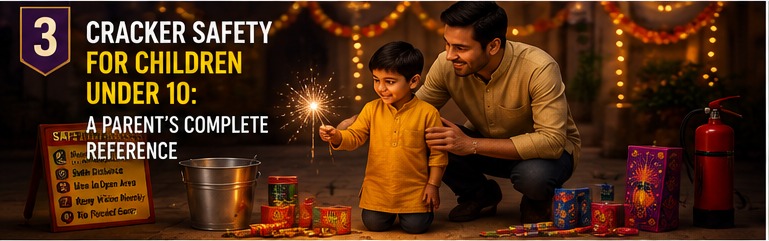
Cracker Safety for Children Under 10: A Parent's Complete Reference
Young children experience Diwali with pure wonder — but their safety around crackers requires careful adult planning. This guide covers what is appropriate at each age and how to supervise safely.
Why Children and Crackers Require Special Attention
Diwali is one of the most magical experiences of childhood. The lights, the sounds, the colours in the night sky — children absorb all of it with a sense of wonder that adults often wish they could recapture. But the same sensory richness that makes Diwali magical also makes it a moment requiring careful parental oversight.
Children under 10 do not yet have the reflex speed, grip strength, or danger awareness of adults. What looks like a simple sparkler or a small ground cracker can cause serious burns in less than a second if something goes wrong. Understanding what is appropriate for which age group, and how to supervise it, is the most important thing any parent can do before Diwali night.
Age-Appropriate Cracker Guidelines
Under 5 Years
Children under 5 should not handle any cracker, including sparklers. Their motor control is not yet developed enough to hold a burning item safely, and they may instinctively reach toward the flame or sparks out of curiosity.
Appropriate for this age group: watching from a safe distance (at least 5 metres from any lit cracker), held by a parent.
Ages 5 to 7
Children in this range can handle short sparklers (10cm) under direct one-on-one adult supervision. The adult should light the sparkler, hand it to the child, and remain within arm's reach at all times.
- No sound crackers
- No ground spinners held in hand
- Sparklers only, held at arm's length
- Immediately guide the child to drop the spent sparkler into a water bucket
Ages 7 to 10
Children in this age group can handle sparklers of any standard length and can watch adult-operated ground crackers from a safe distance. They should not light crackers themselves.
By this age, children can begin to understand and follow safety rules. Use Diwali as a teaching opportunity — explain why certain crackers are for adults only and involve them in the safe parts of the preparation.
What to Prepare Before the Evening
Preparation prevents accidents. Before the celebration begins:
- Dress children in cotton clothing — synthetic fabrics melt and cause worse burns
- Tie back long hair before going anywhere near crackers
- Remove all scarves and loose accessories
- Apply a small amount of water to any exposed arm skin before a child holds a sparkler
- Set up a water bucket as the designated sparkler drop zone — show children exactly where it is before starting
The Adult Supervision Rule
Every cracker that is lit in the presence of children must have a dedicated adult watching it. This means one adult per cracker, not one adult supervising five children with five crackers. The moment you are distracted — talking to another adult, answering a phone — is the moment an accident is most likely to happen.
Designate roles: one adult lights, one adult watches the children. Keep these roles consistent throughout the evening.
What to Do If a Burn Happens
Despite precautions, accidents can occur. If a child is burned:
- Do not apply ice — it can cause further tissue damage.
- Run cool (not cold) water over the burn for 10 to 20 minutes.
- Cover loosely with a clean, non-fluffy cloth.
- Seek medical attention for any burn larger than a 50-paise coin in diameter or any burn on the face, hands, or joints.
Keep the national burns helpline number and the nearest hospital's emergency number saved in your phone before Diwali begins.
Making It Joyful and Safe
The goal is a celebration that children remember as magical, not frightening. Keep the sparkler sessions short, end on a high note, and praise children who follow the safety rules. A positive experience sets the foundation for a lifetime of safe and joyful Diwali celebrations.